Wednesday, November 30, 2011

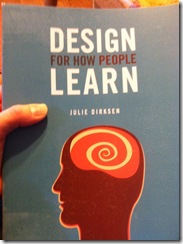
Design for How People Learn by Julie Dirksen @usablelearning

If it’s possible to be in love with a book, then I am in love with this one.
photo (11)
Julie Dirksen has written a most excellent book for the beginning practitioner as well as the seasoned veteran of instructional design: Design for How People Learn.
She explains theory in easy-to-understand terms, provides lots of examples and real world situations to help you see how you can apply the principles she's talking about to your elearning programs.
I'm buying this for my design team and will recommend this to clients as an essential book for their learning design libraries.
Best part is she writes in a real, human voice – very accessible.  Like you’re sitting down with her having coffee and talking about her passion.  And you actually understand what she’s talking about.
(On a side note and what really blows my mind: I hung out with Julie a bit at a conference in May in Orlando and she was talking about this book she was about to start writing…Clearly, Julie wrote her heart out this summer.  I’m sure there was great effort involved, but it does seem as if this knowledge just flowed from her brain right into a published book.)

Wednesday, November 23, 2011

Thanks!

Another good year and many thing to be thankful for on a personal and professional level:

I'm incredibly thankful to be a part of the Kineo team and to have the opportunity to work with some truly fabulous people. I'm proud of the work we do and happy that we all push each other to do better work every day. Thanks!

I'm thankful for my creative and excellent clients, without you there'd be no point. Thanks!

I'm thankful for my fantastic PLN: passionate and committed learning professionals on Twitter and Facebook who teach me something every day and make me laugh even more. Thanks!

I'm thankful for all the industry smarty pants who write books and articles and blog posts that expand my thinking and move me in new directions. Thanks!

I'm thankful for the opportunities I've had to speak and write this year with organizations like the Elearning Guild, ASTD, HR.com, PMI and Elearn Magazine. You all make me better Thanks!

I'm thankful for cool technology that lets me write a blog post while standing next to the stove while I prepare to bake the annual pecan encrusted sweet potato pie! I'm thankful for my blog and I'm thankful for those of you who actually read it and comment here and inspire me. Thanks!

I'm thankful for my kids who host things like drawing club on weekday nights so I can scribble around and draw hand turkeys. You help me tap my creativity and push my patience and fill me with love. Thanks!

And now to that pie baking...

Tuesday, November 22, 2011

Mirror, Mirror: elearning that shines from the inside….

mirrormirror

“Mirror, mirror on the wall, who is learning here at all?”

We’ve all seen a lot of elearning fall flat for a lot of reasons, but one of the biggest reasons is that it’s often simply used as a vehicle in which to dump impersonal information.   Are you in the e-learning at all? To paraphrase Lionel Ritchie (something you should do very carefully): Hello – is it you you’re looking for?

Read more of the latest Kineo top tip: Tip 61: Making it Shine from the Inside - Reflection Counts

Wednesday, November 16, 2011

Veterans Affairs Learning University at Corporate University Week

My live blogged notes from Corporate University Week.
Alice Muellerweiss, Dean at Veterans Affairs Learning University
Trained 200,000 in the first 9 months of the learning organization. Veterans Affairs Learning University (VALU) started in 2008ish…
Support over 20,000 Veterans
Strengthen the way we serve veterans by employing more veterans – Recruit, Retain, Reintegrate our Veterans
VA for Vets program: goal is 40% Veterans working within VA
Diverse mission (still serving two family members from the Civil War!)
Mission to transform the VA to a 21st Century Org. We had antiquated systems and processes. Had a staff of 16 – had to hire in a leadership team…
16 initiatives from healthcare to backlog to human capital.
People will make the mission. Taking care of people is about developing them.
Had three stovepipes: Health, Benefits and Memorial Affairs
Created competencies, measurement, lots and lots of activities…
Don’t have a brick and mortar…people go to training on their site (more convenient for student).
When do bring in sr. execs use other people’s infrastructure (hotels) – to save money, to stay agile
10% training is f2f; 90% is online.
MyCareer at VA – just rolled out this portal. employees can see and chart their path for development. Tools to determine if they’re fit for a particular job.
In the military, you have a path…from private to general.
People leave their organizations for two reasons: their supervisor, lack of career development.
Reginald Vance, was IT initiative lead – became Director of Learning Infrastructure at VA
Human Capital Investment Plan (HCIP) – 4-5 projects identified (these pulled out to 22 projects that needed to be managed)
VA LMS was one of the first and last projects on that list.
Wanted it to be as easy as buying books online.
MyCareer at VA: Prepare, Explore, Plan, Develop – employees go into system and assess themselves to see where they are, start looking at jobs at the next level. This system just launched.
To be competent in your job to better serve our Veterans.
Providing competency model for employees, giving a career mapping tool – from an LMS to a full Talent Management System – no one else was doing this in Federal govt.
The old LMS – no one liked. Hard to log in, hard to pull records.
Went out and asked stakeholders what they needed, what they liked/didn’t like about system. We scrubbed everything and went back to the drawing board.
Use Plateau SaaS model as the TMS.
Serve 350,000 VA employees. Serve additional contractors.
Have since delivered millions of training instances…
  • Simplified reg/login process
  • When first login in – you see a To Do list
  • Some courses are self-assigned
  • Using video vignettes 3 or 7 or 15 minute-ish videos for just-in-time…
  • Tool helps supervisors walk through conversations with employees
  • www.mycareeratva.com (go check it out and use some of the tools – this stuff is public and anyone can use it).
  • Shows you where the jobs are located –
  • Shows what the future of specific jobs is (e.g., in one year it’s not going to be needed), so it’s got some forecasting capabilities
  • Outward facing and inward facing elements of the system.
ROI
At the VA, we have to defend every penny. VA got a ton of money for people development. Working hard to measure the impact.
In two years of investment seeing a pos return of 17% (learner gain on pre and post testing) – but some things have just launched so haven’t started measuring yet.
Seeing a difference in the field in the care our Veterans are getting, customer service…
The Secret Sauce
Having the champion – the senior most champion you can have (Veterans Affairs Secretary Shinseki)
The autonomy for vision (they were given an initiative and then had the autonomy to deliver on that)
Hiring terrific leaders – and empower them to get the job done. Hold them accountable.
The funding
Accountability (Dean Muellerweiss reports weekly and monthly on numbers)
Now have 60+ people on her team – growing to 73; a number of vendor partners; lots of learning leaders across VA (they don’t report to Dean – they help get training to the field);
Initially had to outsource a lot of their training function now looking to bring some of this back in.
Secret sauce:
where strategy fails: when the strategy is developed by one person and handed off.  Have to develop it together.
For the VA – it’s been time critical to launch the portal – if it’s not integrated into the fabric of the VA it could go away with the next political appointment.
Note: later in the afternoon, the VA team won the award at CU Week for best new corporate university.
Developing and Marketing your Learning and Organizational Development Brand at Corporate University Week

My live blogged notes from Corporate University Week.

Developing and Marketing your Learning and Organizational Development Brand

Judy Whitcomb SPHR
Chief Learning Officer, Vice President, Human Resources and Learning and Organizational Development
Vi (formerly Classic Residence by Hyatt)

She started off sharing stories about their organization.

Start with an analysis of how the learning brand is being perceived within your organization. Then figure out where you want to go and what you want to do? Identify 5-6 key words that you want to use to identify your brand within the org.

They started off with the perception that the learning org was a bit difficult…

Learning materials and LMS strongly aligned with their visual brand…

Keys to a successful marketing plan:

  • recognize that emotions are powerful communication tools
  • engage senior leaders in telling the story
  • involve cross-functional leaders to be advocates
  • repetition, repetition, repetition
  • leverage your business policies
  • Recognize how learning will support practices, etc.

Tent cards, emails – what’s new

Ongoing webinars to train and promote features and benefits (don’t turn on allt he features of your LMS right away – let people get used to it

Recognize results

Target learning strategy with specific needs that employees have (“how do I write a better marketing plan?”)

Company newsletters

Linking Succession Planning with Current and Future Biz Needs: Jill Zimmerman at Corporate U Week

My live blogged notes from morning session at Corporate University week.

Linking Succession Planning with Current and Future Business Needs – Talent Review Process Excellence

Jill Zimmerman
Vice President of Talent Acquisition and Development, Human Resources
Discover Financial Services

About Discover

  • Discover = started in 1986; leading credit card issuer, over 50 million card members; also in personal lending and direct banking.
  • Vision: “To the be the most rewarding relationship consumers and business have with a financial services company.”
  • Mission: to help people achieve better financial future

Succession Planning

  • Process
  • Tools
  • Key success factors

Key success factor #1: always start with a bus strategy. Proactively build a robust talent pipeline to meet future bus and succession needs.

Key success factor #2: keep both the job and the people in mind. Do we have the right jobs to meet the needs? Do we have the right people?

Key success factor #3: use a common set of metrics. At Discover, set of leadership behaviors that apply to everyone at the company. 

9 box…

photo (7) Have a job scorecard – what skills are required for a job? what leadership skills are required for that job? do you have a successor for that job? is there backfill for that successor? (if there’s not a deep bench, you may have to go outside the company).

Have a people scorecard (focus on the people) – create an accurate depiction of the people. What business skills? What leaderhip skills? What do we need to do with this person? identify individual gaps.


Key success factor #4: development must be on-going.

70/20/10 model:

  • 70% experiential – things people can practice and do on the job
  • 20% learn from others – mentors, coaches, managers, role models
  • 10% learn on own – classes, articles, books

People usually identify that 10% – but we need to get better at identifying the 70%

Key success #5: CEO/COO must be active owners

Ongoing mindset; dedicated time; trusting and transparent discussion; accountability

Create a Candidate Slate

How will you know if you’re successful?

  • Retention
  • Engagement
  • Internal Mobility

When people feel there’s opportunity, movement and growth – they’re more engaged. (They do anonymous surveys that is tied back to other data so they can see who’s staying, who’s transferred and who’s more engaged).

Retain and engage your most critical resources.

What are people good at? What are they interested in? What business needs can they meet?

Have done exit surveys – 3 years ago #1 reason people were leaving was internal mobility. Today’s it’s other reasons like relocation…

Tuesday, November 15, 2011

Leveraging Technology to Drive Business Value (University of Farmers) at Corporate University Week

My live blogged notes from today’s closing session at Corporate University Week.

Leveraging Technology to Drive Business Value

Art Dobrucki, CPCU
Director of Learning Strategy & Performance
University of Farmers- Farmers Insurance Group of Companies

Start with the end result in mind. What model do you use in your org? At its heart does it have business value?

Create a technology roadmap for learning: What technology solutions will help people do their jobs better? lay that over the technology solutions you have. Figure out where you want to go.

Some things they’re doing at U of Farmers…

Making use of video – they now have a video studio – think breaking news stories with experts to keep employees informed about a current crisis (Farmers = insurance company). Then repurposing these videos in the LMS, for mobile, etc.

Audience Response systems

Using iPads with video to record roleplays and then review them with instructors.

Have two brick and mortar university facilities. (19 classrooms, offices, webinar rooms, assessment center, media studios, learning labs – cars to get under and look at damage, houses to explore)

Seven years ago he had a department of seven. Had a huge issue with retention –alarm bells were going off. Needed to develop and retain talent.  Demonstrated that learning was able to drive results that the company was looking for with agents.  Built on that success. Start demonstrating business value to get the investment…

A learning portal

Reskinned their learning portfolio – there are pathways to go depending on whether you’re new employee, on a leadership path, etc. RSS feeds.

Mapped competencies to make it easier for people to find resources. (14 leadership competencies that applied to everyone; 28 additional core competencies).

So click on “Coaching” or “Negotiating” – go to a page with definitions, self-assessments (what’s my level of competency), then direct people to resources: books, courses, recommended experiential activities (what conversations should I be having? what should I be doing?)

Are your portals just a gateway to your LMS or have you mapped your content and resources to help employees find what they need to master particular competencies?

Engaging learners in the moment of need

Think about the trends in the marketplace

Think performance support!

Capability Readiness for a Changing Workforce

Mobile and tablet devices.

Don’t put courses on them – but information you need to know at the point in time (e.g., about to go make a sales call at a dry cleaners – top five questions to ask)

As new devices come out – buy one or two for your department and bring them in house so people on your design team can start playing with them.

At Farmers, starting doing podcasts when iphones started coming out – found out not a lot of demand for that – so now using those skills in video…keep experimenting and see what works for your organization’s needs.

$100K per year on training binders – instead put those guides onto iPads that they use for the training week.  Can take notes and annotate the guides and then send them to yourself at the end of the week. Training dept refreshes the ipad at the end of the week.

Using videos to assess sales skills – video gets uploaded to a server and the certified teachers evaluate the skills.

Remember that you can’t always hit home runs. If you say everything’s a home run, you’re going to start losing credibility. (Start measuring!)