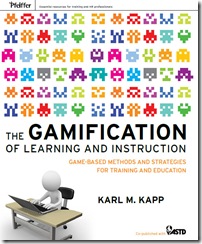
 It’s the Cammy Bean stop on the blog book tour for Karl Kapp’s newest book: The Gamification of Learning and Instruction: Game-Based Methods and Strategies for Training and Education
Karl Kapp is a professor of instructional technology in Bloomsburg University’s Department of Instructional Technology in Bloomsburg, Pennsylvania. He’s one of my favorite professors that I've never actually studied with (although he has taught me a ton). Over the years, Karl and I have had wonderful arguments about gamers and gender and instructional design. He took me on my first tour of Second Life and opened my eyes to the possibilities of virtual worlds. He wasn’t my professor, he just wanted to share. So thanks, Karl, for sharing with all of us yet another thoughtful book about a topic on everyone’s minds these days: gamification and learning. And now I’ll share a few thoughts of my own…
If you think gamification is just about putting badges into your courses, then this book is for you.
If you're still on the fence about whether games work for learning, then this is certainly the book for you.
If you need to gain buy-in for games within your organization and need to know what theories to cite to support your arguments, this is the book for you.
If you need some examples of how games can be used in learning, yep, this is the book for you.
But if you really want to start designing and creating games, go out and play 'em.
But still, that's not enough. There's a practical element we’re going to need if we’re really going to get this learning game thing right, so I just want to take a moment to focus on what it will take to build a game within an organization.
In Chapter 9 "Managing the Gamification Design Process", Karl talks about the process for designing a learning game and who you'll need on your team. At the moment, I suspect this project team list will be too daunting for most internal organizations:
"The following team members typically are involved with a project for the gamification of learning and instruction. Not all of these individuals will be involved every time. It depends on the size and scope of the project. However, a project manager, instructional game designer, artist, at least one subject-matter expert, and a programmer or two are almost always involved."(Karl then goes on to talk about the need for animators, music/sound technician, and other specialized roles.)
Karl says if you don't have an instructional game designer (and these are hard to come by), you should go out and get an instructional designer who likes to play games. But if you then consider that many organizations, especially smaller ones, are working with "home grown instructional designers" (who are maybe just powerpoint jockeys or really good at Captivate, but not actually instructional designers in the truest sense), then I'm not sure that many organizations will be able to do this in-house -- or at least not do it well. I'll go out on a limb and say this bodes well for the growth of the outsourced instructional game design companies!
Karl doesn't talk much about budgets or time frames in all of this, but something to bear in mind. Seems like it takes more time and more money than a lot of organizations have for a lot of their "learning" projects. Karl, what say you? (And he'll probably say something like, "it doesn't have to take more time or more money".)
Jeannette Brooks of Articulate wrote about the book just yesterday and talked about how Storyline (Articulate’s soon to be released development tool) will put “gamification within easy reach of any e-learning developer.” What do you think? Will Storyline make this all possible? I suspect there’s more to good game design than the tool though, right?
So should there be more learning games? Absolutely. Will more organizations design and build them. Absolutely. Will there still be a lot of the same old training solutions coming out of the same old training departments? Most likely...
So I'll leave you with this cautionary tale from Karl Kapp:
"Too often the learning profession embraces a new concept as the answer to all learning problems and overhypes the concept to the point of backlash. It is important to approach the gamification of content and learning carefully and methodically. If gamification is seen as a panacea and applied to every single learning event, it will quickly become trivialized and non-impactful. Stay focused on using gamification for the right learning outcomes."(Which is to say, don't be part of the problem. Instead, go out and read Karl’s book and find out why gamification isn’t just badges and points, but much, much more….)
Game on.
Follow the conversation on Karl’s Facebook page: http://www.facebook.com/gamificationLI
And be sure to buy the book: The Gamification of Learning and Instruction.
And a final note about our modern lives and the need for games…
This really has nothing to do with Karl's book, but more just a pesky rant I've got in me about games and gamification in general. It seems our modern world has lost so much purpose...we need and want to be entertained because most of the challenge is gone (a very first world problem)...or we need to be numbed to the challenges we do have. And now we need to dress up our boring jobs with games because otherwise who wants to learn them or even do them...I don't know. Kind of makes me sad…
